If you’re evaluating microfiber cleaning systems for commercial janitorial teams, you’re already past the “buy a few clothes and hope for the best” stage. You’re looking for a repeatable system that improves soil removal, reduces cross-contamination, speeds up workflows, and keeps quality consistent across shifts and sites. Done right, microfiber isn’t just a tool—it’s an operating standard your team can train, measure, and scale.
This guide breaks down what a true microfiber program includes, how to deploy it in real facilities, and what to watch for so microfiber delivers results instead of becoming “just another supply closet item.”
Why Microfiber Works Better in Commercial Facilities
Commercial spaces create layered soils: tracked-in grit, skin oils on touchpoints, breakroom residue, restroom biofilm, and fine dust that makes surfaces look dull even after “cleaning.” Microfiber is engineered to grab and hold that soil more effectively than traditional cotton materials—especially when your team follows a zoning and laundering protocol.
Authoritative infection-control guidance also notes microfiber cloths are often preferred for cleaning cloths and mop heads because they can remove more dirt and microorganisms—but they can be damaged by certain high-pH chemistries, so product compatibility matters. See CDC cleaning supplies guidance.
The business outcomes that matter
- Cleaner touchpoints with fewer missed areas
- More consistent floors (less haze, less redepositing)
- Lower cross-contamination risk through color-coding and pad changes
- Faster room turnover with “grab-and-go” prepped tools
- Better training compliance because the system is easy to standardize
What “Microfiber Cleaning Systems” Actually Means
Buying microfiber is not the same as running a microfiber system. Microfiber cleaning systems for commercial janitorial teams typically include four components: tools, chemistry control, zoning, and laundering.
1) Tools: Cloths, pads, and frames built for process
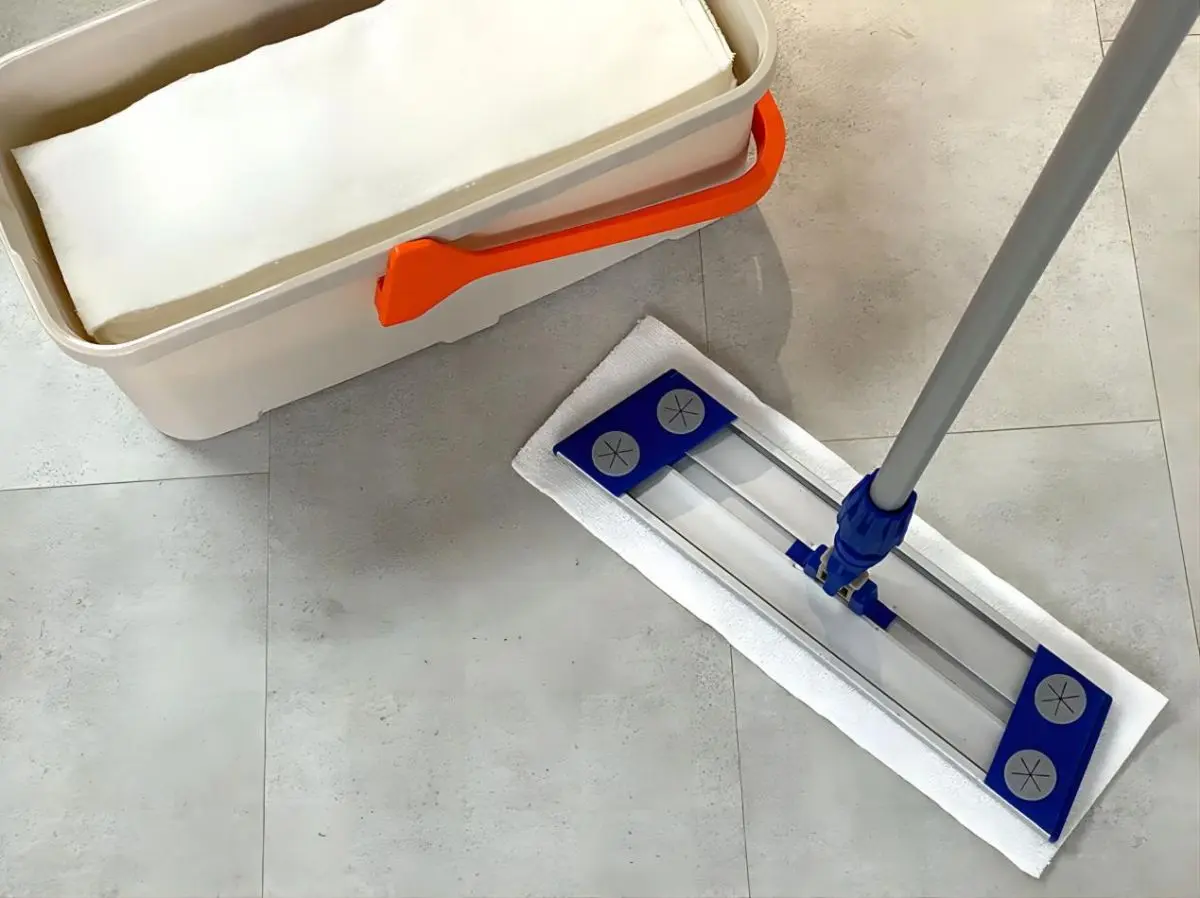
- Flat microfiber mops with interchangeable pads (instead of string mops)
- Microfiber cloth sets designated for glass, general surfaces, and restrooms
- High-dusting tools (wands/sleeves) for vents, ledges, and partitions
- Closed-bucket or spray systems that reduce “dip-back” contamination
2) Chemistry control: the right product, measured the right way
Microfiber performs best when chemicals are consistent and not over-applied. Over-wetting pads can push soil around and increase drying time. Under-wetting can reduce pickup and create streaking.
3) Zoning: color-coding that prevents cross-use
A microfiber program should make it impossible to accidentally use a restroom cloth in a breakroom. Color-coded sets create that protection.
4) Laundering: where most microfiber programs win—or fail
If microfiber isn’t laundered and stored correctly, it stops gripping soil, starts smearing, and becomes a cross-contamination risk.
Zoning and Color-Coding: The Simple Rule That Prevents Spread
The quickest way to improve quality is to build zones around risk and traffic, then assign microfiber sets to each zone.
A practical zoning model
- Restrooms: highest-risk soils, dedicated cloths and pads only
- Breakrooms: food contact surfaces and appliance touchpoints
- General office: desks, conference rooms, common areas
- Glass & entry: interior glass, doors, high-visibility first-impression zones
To see how zoning, pad swaps, and touchpoint lists reduce cross-contamination in daily operations, use this reference: workplace cross-contamination prevention cleaning.
Pre-Charged Pads vs. Bucket Dipping: The Upgrade That Changes Everything
Traditional mopping often spreads soil because the same bucket solution is reused too long. With microfiber cleaning systems for commercial janitorial teams, the modern approach is pre-charged pads (pads pre-moistened with measured solution) or closed-bucket systems.
Why it works
- Every room/zone gets a fresh cleaning surface
- No “dirty dip” that contaminates solution
- Easier to train and audit (“pads used per zone” is trackable)
- Faster floor drying in many environments
A real-world workflow example
- Start with a clean pad for entry/traffic lanes
- Swap pads before restrooms
- Swap again before break-room floors
- Bag used pads for laundering (no re-dipping, no reuse)
Training Microfiber Like a System
A microfiber program should be teachable in minutes, not weeks. The key is to train sequence + accountability, not just “wipe stuff down.”
A field-ready microfiber training framework
- Clean-to-dirty flow: lobbies → offices → break-rooms → restrooms
- High-to-low technique: ledges/fixtures first, floors last
- Fold method for cloths: 8 clean sides per cloth before changing
- Pad change triggers: restroom entry, visible soil loads, zone changes
- Touchpoint list: handles, switches, shared devices, rails, breakroom pulls
H4: The “smear test” your supervisor can use
If a surface looks clean but feels tacky or streaks under light, it’s often one of three issues:
- Cloth is saturated or overloaded with product
- Cloth/pad is dirty or not gripping soil due to laundering problems
- Wrong chemistry for that soil type (oil/grease vs. dust/particulate)
Best-practice laundering habits
- Launder microfiber separately from cotton (lint reduces performance)
- Avoid fabric softeners that coat fibers and reduce pickup
- Dry fully and store in clean, closed containers by zone/color
- Retire cloths/pads that no longer grip soil or leave streaks
Where Microfiber Systems Deliver the Biggest ROI
Microfiber is most valuable where consistency matters and cross-contamination risk is high.
High-return applications
- Restroom sanitation routines (dedicated cloths + pad swaps)
- High-touch disinfection programs (consistent wipe coverage)
- Open-plan offices (dust control and faster resets)
- Conference rooms (glass, tables, chair arms, remotes)
- Entryways (better particulate pickup reduces “dirty floor” perception)
If you’re trying to raise quality without expanding labor hours, microfiber cleaning systems for commercial janitorial teams are one of the most practical upgrades—because they reduce rework.
Common Mistakes to Avoid
Even strong teams stumble on the same few errors:
- Treating microfiber like cotton (reusing too long, over-wetting)
- No color-coding (or color-coding with no enforcement)
- Using incompatible chemistry that degrades fibers
- Mixing microfiber laundry with lint-heavy loads
- Not swapping pads between zones (spreading soils)
Want a Microfiber Program Built for Your Site?
We help facilities implement microfiber systems with zone maps, checklists, training routines, and quality audits—so results stay consistent across every shift and every visit.
Call (619) 938-2600 or email info@citywidecleaningservices.com to get started.