Well-run facilities don’t stay that way by accident. They rely on training programs for professional janitorial staff that standardize quality, protect health, and control costs. Whether you manage a single office or a multi-site portfolio, elevating training from “orientation” to an ongoing system is the difference between reactive cleanup and predictable, audit-ready performance.
Why Structured Training Matters
A truly professional janitorial program does three things at once:
- safeguards people, 2) extends asset life, and 3) proves value with measurable outcomes. In practice, that means a curriculum tied to surfaces, risks, and service level agreements—not a one-size-fits-all slide deck. When training programs for professional janitorial staff are built around a facility’s actual traffic patterns and materials, complaints drop, consumable waste shrinks, and work orders get solved on the first pass.
Outcomes Facilities Care About
- Fewer re-cleans and call-backs
- Cleaner restrooms and breakrooms at peak hours
- Longer intervals between floor restorations and carpet replacements
- Documented safety/compliance for audits and bids
Pillars of a High-Performing Curriculum
1) Infection Prevention & High-Touch Discipline
Teach sequenced workflows, dwell times, and touchpoint rotations (handles, rails, elevators, faucets, shared devices). Reinforce cross-contamination controls with color-coded tools and “clean-to-dirty” order of operations.
Pro tip: Align chemical use with surface compatibility, especially on stone, LVT, and acrylic partitions.
2) Floor & Fabric Care Science
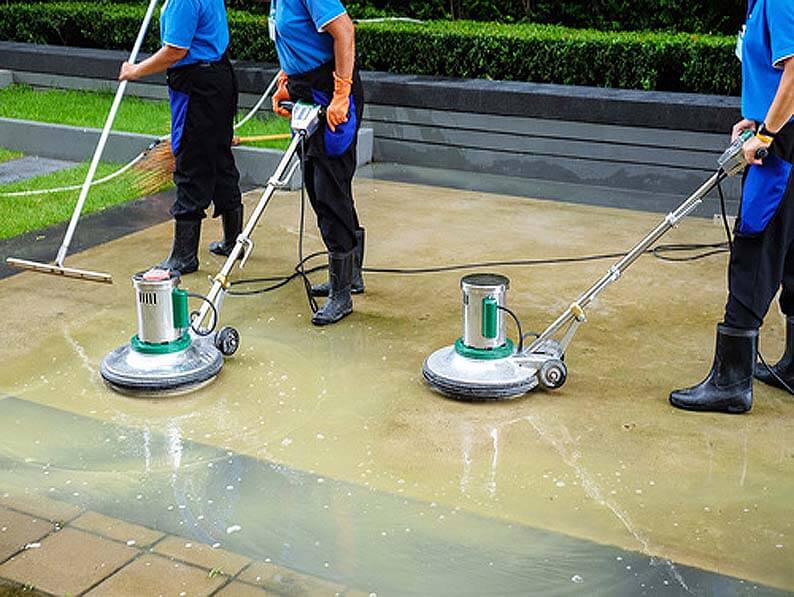
Break down daily care versus periodic and restorative methods so teams know when to dust mop, auto-scrub, encapsulate, or extract. Pair theory with hands-on practice: machine setup, pad/brush selection, strip/rinse/neutralize steps, and moisture control for rapid re-occupancy.
3) Safety & Regulatory Literacy
From SDS interpretation to secondary labeling and PPE selection, safety is non-negotiable. A cornerstone reference is the (OSHA Hazard Communication Standard), which helps teams understand chemical hazards and communication protocols.
4) Customer Experience & QA
Teach how to close the loop with occupants and managers: before/after photos, timestamped checklists, ATP/visual scoring, and escalation paths. A quick “reset walk” at shift end is often the fastest quality win.
How to Deliver the Training (and Make It Stick)
Blended Learning Works Best
Combine micro-modules (mobile-friendly 5–10 minutes), live demonstrations, and supervised practice. Short, frequent refreshers outperform once-a-year marathons.
Handoffs and Shadowing
- Day 1: safety briefing, route walkthrough, and tool set-up
- Week 1: supervised runs on restrooms, break areas, and glass
- Week 2: independent route + targeted coaching on speed vs. quality
Visual SOPs at the Point of Use
Mount QR codes on carts and closets that link to the exact SOP for that zone or machine. New hires become productive sooner, and veterans have a fast refresher when switching buildings.
Assessment: Measure What You Expect
Skills Checklists
- Chemical dilution and labeling
- Restroom sequence and dwell verification
- Auto-scrubber inspection and recovery tank sanitation
- Spot/stain ID and treatment plan on commercial carpet
Performance Dashboards
Track three numbers weekly: complaint rate, re-clean percentage, and time-on-task by zone. Your training programs for professional janitorial staff should show measurable improvement in the first 30–60 days.
Compliance & Risk Management You Can Prove
Documented training protects occupants and your brand. Maintain:
- Attendance logs and quiz scores
- Equipment service records
- SDS binders and chemical inventories mapped to surfaces
- Incident reporting and corrective actions
If you serve regulated spaces, cross-reference your curriculum to relevant guidelines and client contracts. For example, lobby and clinical spaces in healthcare require stricter dwell times and disposal methods. For deeper context, see Healthcare Facility Cleaning Standards.
Building Your Program Step by Step
- Audit the site: note surfaces, finishes, and traffic spikes.
- Define outcomes: “Reduce re-cleans by 25% in 60 days,” “Cut chemical spend 10% via dilution control.”
- Map SOPs to routes: restroom, breakroom, open office, conference, glass, hard floors, carpet.
- Select tools: microfiber system, HEPA vacuums, dilution stations, auto-scrubbers, low-moisture carpet machines.
- Train & certify: deliver blended modules and hands-on competencies; certify operators on each machine type.
- Inspect & coach: weekly QA walks, monthly refreshers, and quarterly skills recertification.
Cost & ROI: Why Training Pays for Itself
- Fewer product errors: accurate dilution reduces chemical overuse and surface damage.
- Less downtime: trained operators minimize machine misuse and extend equipment life.
- Asset preservation: correct periodic care delays expensive floor and carpet replacements.
- Retention: growth paths (lead, trainer, floor tech specialist) reduce turnover, stabilizing quality and schedules.
Partner With a Team That Trains Like Pros
City Wide Cleaning Services builds and delivers training programs for professional janitorial staff tailored to your building type, from offices and retail to healthcare, education, and industrial sites. We stand up SOPs, certify crews, and report results you can share with stakeholders.
- Call: (619) 938-2600
- Email: info@citywidecleaningservices.com
FAQ
How often should staff be retrained?
Run quarterly refreshers and immediate micro-training whenever a surface, chemical, or complaint trend changes.
Do we need different training per site?
Yes—surfaces, traffic, and risk profiles differ. Keep a common core, then add site-specific modules.
Can supervisors train in-house?
Absolutely. We create train-the-trainer kits with checklists, videos, and assessment rubrics so performance stays consistent.